
I've been watching a lot of cooking shows lately. Top Chef, Culinary Class Wars — the kind of shows where chefs make these incredible, ambitious dishes under pressure. Restaurant-style food. Fine dining plating. Techniques I've never heard of. And every time I see a dish I want to make, I run into the same problem: the show gives you maybe 30 seconds of screen time for something that took the chef four hours. You see the finished plate, you hear a few ingredients mentioned, and that's it. You think "I should make that" and then a week later you've completely forgotten about it. And even if you do remember, actually cooking the dish means you're on your own, piecing it together from food blogs, YouTube videos, and guesswork.
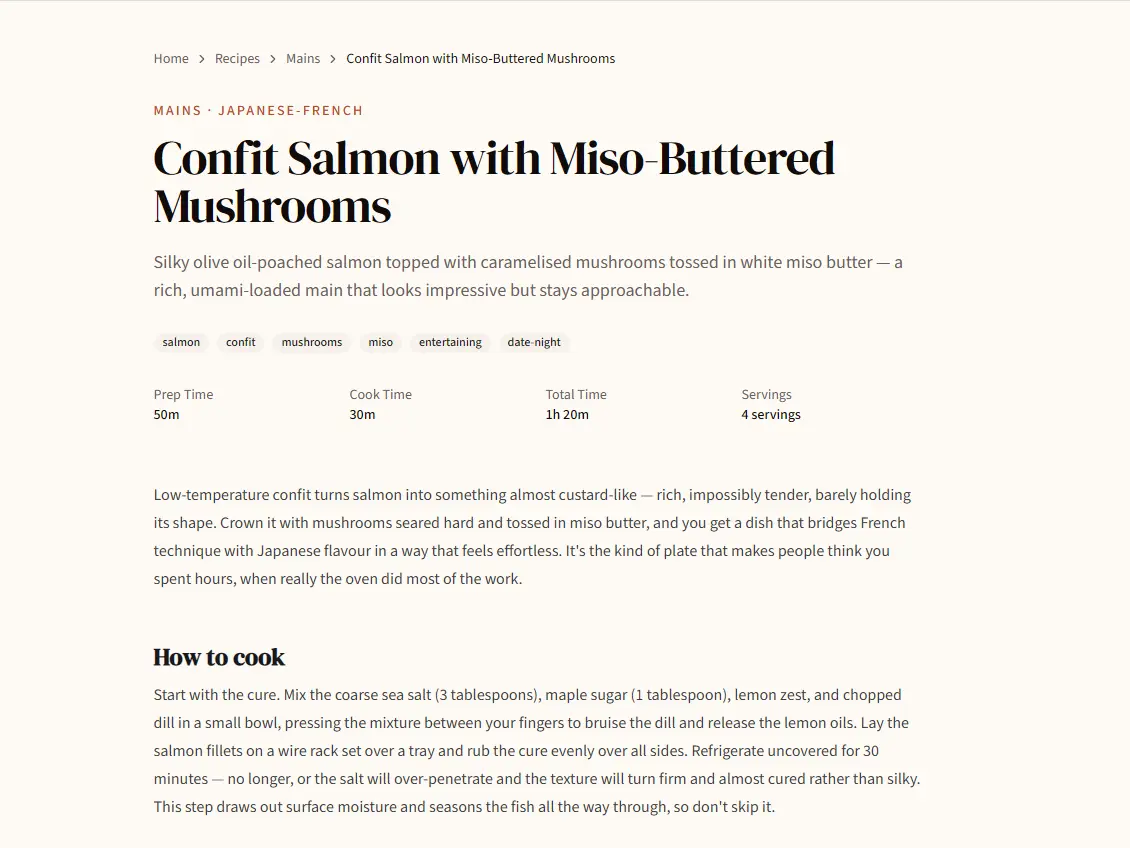
So I built Full Send Kitchen to fix that. The idea is simple: collect these restaurant-style recipes, fill in the gaps, and make them approachable for home cooks. Not dumbed down, but translated. The goal isn't to simplify the food — it's to give you enough context and technique to actually pull it off in a home kitchen.
I've actually built a recipe site before. Gustavs Kitchen is focused on everyday Swedish cooking — the kind of food you make on a Tuesday when you just need to get dinner on the table. Full Send Kitchen is the opposite end of the spectrum. This is what you cook when you have friends coming over on Saturday night and you want to do something special, or when you're trying to impress someone on a date. There's a weird gap in the recipe internet: on one end you have "30-minute weeknight chicken" blogs, and on the other end you have Michelin restaurant cookbooks that assume you have a brigade and a Pacojet. There's not much for the ambitious home cook in between.
This is a content website and we're not doing anything complicated, so Next.js feels like a natural fit. Put it on Vercel and you get all their platform stuff out of the box — preview branches, image optimization, caching, CDN. I spent way too much time on Gustavs Kitchen optimizing images and trying to get caching to work correctly. I really value having that just work. Now that I do more and more from my phone via Claude Code, preview branches have become super valuable. I can push a branch and see the result on a real URL before merging anything. No laptop needed. It's one of those things that sounds minor but completely changes how you work.
The rest of the setup is bare bones on purpose. Each recipe is two files: a markdown file for the free-text content — the story, the technique explanations, the context — and a JSON file for the structured data like ingredients, steps, categories, and tags. The JSON gets used for building the category and tag pages and for displaying the recipe steps and ingredient lists.
The urge as an engineer is to build a proper data model for ingredients.
Normalized names, amounts, and units. Separate fields for quantity, measurement,
and item so you can scale recipes, convert between metric and imperial, and
compare ingredients across dishes. I know because I've done it before, and it
was a constant source of bugs. Bad pluralization ("1 tomatoes"), weird edge
cases ("a pinch of salt" — what unit is "pinch"?), and degraded experiences for
no real benefit. I never ended up using any of the fancy features it was
supposed to enable. So this time, ingredients and steps are just string arrays.
"2 cups heavy cream" is a string. "1 vanilla bean, split and scraped" is a
string. They exist to be displayed, not computed over.
For the content itself, I've kept it just as simple. I've previously written a few different CLIs and agent loops for generating content, but I'm more and more bearish on writing your own agents. The existing harnesses are good, and they're where I spend most of my time anyway. I want my recipe writing to happen there too.
Instead, I built an "add recipe" skill. I like skills. The idea of turning the agent from a very general tool, doing average things, into a focused workflow follower is compelling to me. The skill covers what the inputs should be — normally just a short description of a dish — and then prompts for references or images so we can narrow down what to write. We describe the output format and what we want the content to read like: educational but inspirational, ambitious but grounded in the reality that we're writing for home cooks, not restaurant kitchens. It's all about adding guard rails and narrowing the scope of the agent so it does the one thing well.

I didn't go to culinary school, but Claude probably knows most cooking techniques, especially all the French ones I struggle to pronounce. Since the whole point of this project is to become a better cook and learn these skills, I had Claude create a set of reference files describing techniques — blanching, brining, mounting, tempering, and so on — explaining what they are and when to use them. The skill references these files, which means every recipe that mentions "mount with butter" explains it consistently, and I get to learn the concept properly. It's basically a style guide, but for cooking knowledge instead of prose.

So does it work? I made a Coconut Bread Pudding with Pineapple Cream from Top Chef, and it was delicious.

Building things for yourself is still one of the best reasons to write code. Not everything needs to be a startup or have a growth strategy. Sometimes you just want to cook a great meal for your friends, and you need a good recipe to get there.